

You have a great idea. You’ve validated it with friends, maybe even a few potential customers. Now the question everyone asks: Do we build a website or a mobile app?
It feels like a tech decision. It’s not. It’s a business decision — one that affects your runway, your time to market, your ability to learn, and ultimately whether your startup survives its first year.
At Vistrasa, we’ve helped dozens of founders navigate this exact fork in the road. The answer is rarely obvious, and it depends heavily on what you’re building, who you’re building it for, and what stage you’re in. Let’s break it down.
“Build the minimum that teaches you the maximum. Everything else is expensive guessing.”
Why This Decision Matters More Than You Think
A mobile app typically costs 3–5× more than a web application and takes significantly longer to ship. You need to build separately for iOS and Android (or invest in cross-platform frameworks), navigate app store approvals, and manage updates through review cycles you don’t control.
A website, on the other hand, is accessible from any device with a browser, deployable in days, and infinitely easier to iterate on. But it doesn’t mean websites are always the right answer — certain products genuinely require native app capabilities that the web simply cannot replicate.
The risk isn’t picking the wrong option. It’s spending 6 months and your entire seed on the wrong option before you’ve learned anything real about your market.
The Core Difference: Access vs. Experience
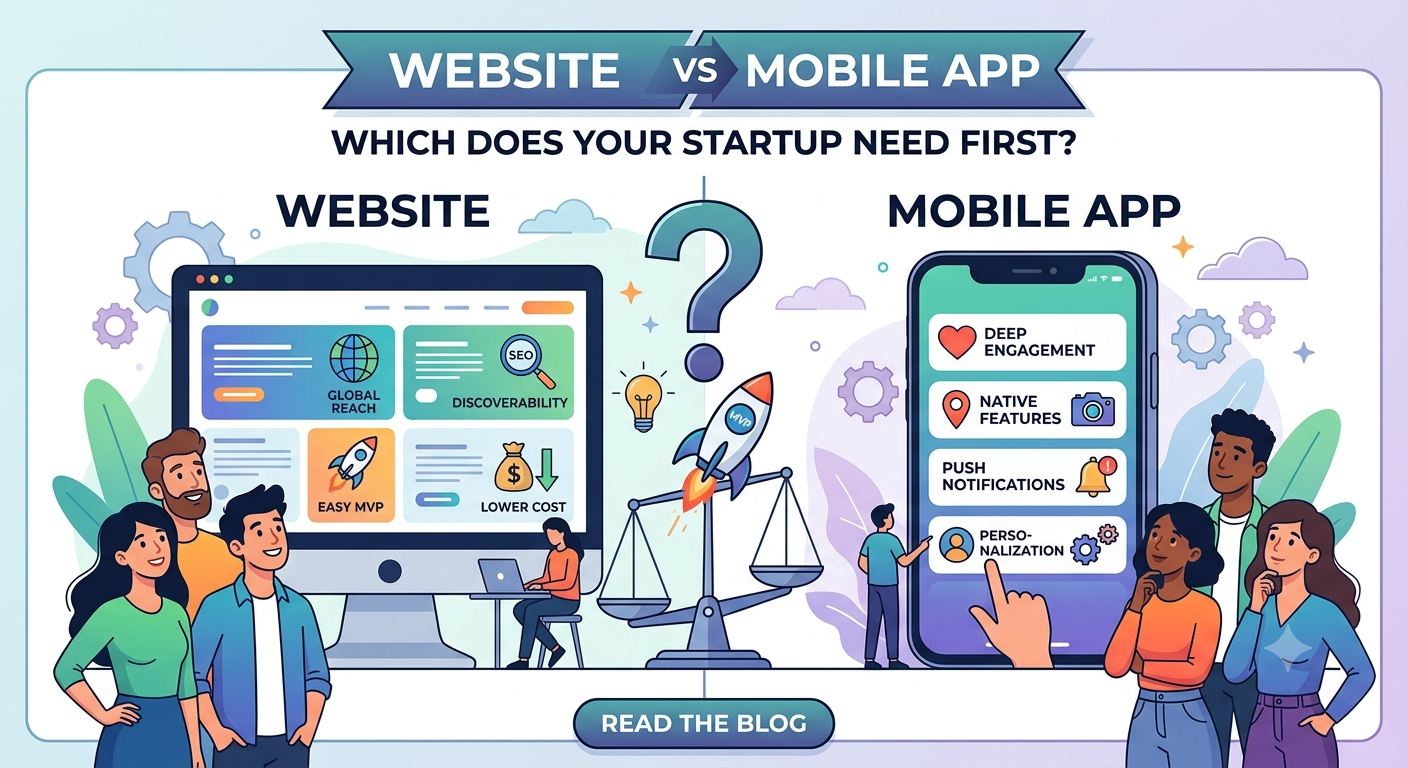
Here’s a useful mental model. A website optimizes for access — anyone with a link can reach it, Google can discover it, and investors can review it. A mobile app optimizes for experience — deeper engagement, device integrations, and habitual daily use.
Ask yourself honestly: is my core value delivered through access to information or a service, or through a frequent, immersive, device-native experience?
| Factor | Website | Mobile App |
|---|---|---|
| Time to launch | Weeks | Months |
| Development cost | Lower | Significantly higher |
| User acquisition | SEO, social, direct link | App store discovery only |
| Iteration speed | Deploy anytime | App store review required |
| Offline access | Limited | Full support |
| Push notifications | Basic (web push) | Rich, reliable |
| Device features | Partial (camera, GPS) | Full access |
| User trust signal | Moderate | App store badge helps |
| Retention mechanism | Email, bookmarks | Home screen, notifications |
Start With a Website If…
The vast majority of early-stage startups should build a website first. Here’s when the case is especially strong:
You’re still validating product-market fit
If you don’t yet know exactly what features your users will pay for, a website lets you test hypotheses quickly and cheaply. You can ship a landing page with a waitlist in a day, a functional MVP in two weeks, and iterate based on real feedback — all before an app would even clear App Store review.
Your product is B2B or SaaS
Businesses buy on desktops. Sales calls happen over browser-based demos. Procurement decisions are made by people sitting at their computers. A polished web product almost always wins here, and a native app adds complexity without proportionate value.
Your growth relies on content or SEO
If organic search is a meaningful channel for you — and for most startups, it should be — a website is the only way to capitalize on it. Apps are invisible to Google. Every blog post, guide, and landing page you publish builds compounding traffic a mobile app can never replicate.
Your users are occasional, not daily
Booking a service, making a purchase, comparing options, reading reports — these are low-frequency, high-intent actions. Users don’t need an app on their home screen for something they do once a month. A fast, mobile-optimized website is a better experience for them and a better investment for you.
B2B SaaS, marketplaces, e-commerce, media, portfolio, lead gen, service businesses, anything needing SEO growth.
Fitness trackers, dating apps, real-time communication tools, games, anything requiring daily native engagement.
Go With a Mobile App First If…
There are genuine cases where a mobile app is the right first move. These tend to share a common trait: the product’s core value is inseparable from device-native behaviors.
- The product requires daily or multiple-times-daily usage (habit-forming)
- You need reliable push notifications as a core engagement mechanism
- Your experience depends on camera, GPS, accelerometer, or health sensors
- Offline functionality is non-negotiable for your users
- Your target audience is mobile-first with low desktop access
- You have enough runway to support 6+ months of development before launch
- You have validated the concept thoroughly before writing production code
Think of apps like Strava, Headspace, Duolingo, or any consumer fintech wallet. The product only makes sense on a phone, used every day, with notifications and sensors as core features. If your startup fits this profile, yes — start with the app. But validate the concept first, even if that means a scrappy landing page and manual onboarding.
The Hybrid Path: Progressive Web Apps (PWAs)
Here’s a middle ground that many founders overlook: Progressive Web Apps, or PWAs. A PWA is a website that behaves like a native app — it can be added to a home screen, send push notifications, work offline, and access certain device APIs.
For many startups, a PWA gives you 80% of the app experience at 20% of the cost. You ship faster, maintain one codebase, and avoid the App Store gatekeeping entirely. Companies like Twitter, Pinterest, and Uber have shipped PWAs that perform comparably to their native counterparts for many use cases.
It’s not perfect for everything — deep hardware integrations and the most complex native UX still require true native development. But if you’re on the fence, a PWA is often the smartest first bet.
A Framework for Deciding
Before you make the call, answer these five questions honestly:
- How often will my users interact with this product? (Daily = lean app; weekly or less = website)
- Do I need device sensors or offline capability to deliver my core value?
- Is my primary growth channel SEO, paid ads to landing pages, or word of mouth links?
- How much runway do I have, and how quickly do I need to learn?
- Have I already validated that users want this, or am I still exploring?
If the answers point you toward a website, build a great one — not a placeholder. Make it fast, mobile-responsive, and conversion-optimized. A high-quality web product built in weeks will teach you more than a half-finished app built over six months.
The Vistrasa Verdict
For most early-stage startups: start with a website. It’s faster, cheaper, and more forgiving when your product evolves (and it will evolve). Use it to validate your core assumptions, build an audience, and generate revenue. Once you’ve proven that users want what you’re building — and you understand how they use it — you’ll have all the information you need to build a mobile app that people will actually download and keep.
The best time to build a mobile app is when you’ve outgrown what the web can do for you. Not before.
How Vistrasa Can Help
At Vistrasa, we specialize in helping startups make exactly these kinds of decisions — and then executing on them with precision. Whether you need a high-converting landing page, a full-stack web application, or a native mobile app built for scale, we bring both strategic clarity and technical depth to every engagement.
We’ve helped founders move from idea to live product in as little as four weeks. We’ve also helped teams avoid wasting months on the wrong platform by helping them pressure-test assumptions before a line of code is written.